The Ontario SPCA and Humane Society is excited to announce the grand opening of the new Ontario SPCA Sudbury Regional Veterinary Clinic, in partnership with Collège Boréal. This initiative is part of our ongoing commitment to increasing access to veterinary services across Ontario, with a focus on addressing the unique challenges faced by Northern communities.
Located at 21 Lasalle Blvd. on the Collège Boréal campus, the clinic will provide spay/neuter procedures and basic veterinary services for publicly owned dogs and cats, local animal rescue organizations, and animals in the care of the Ontario SPCA Sudbury & District Animal Centre.
Supporting pet families in the North
The new clinic will help ensure more animals have access to essential veterinary care while also supporting the training of the next generation of veterinary professionals. As a hands-on learning facility for students enrolled in Collège Boréal’s Veterinary Care Technician program, the clinic offers future Registered Veterinary Technicians the opportunity to gain valuable experience and skills.
“This partnership not only helps us provide access to veterinary services in the community, but it also helps us train more veterinary professionals,” says Sonya Reichel, Vice President of Operations, Ontario SPCA and Humane Society. “With veterinary shortages reaching crisis levels, particularly in Northern Ontario, this clinic is one step toward addressing the growing needs of the community.”
How to access services
Registration for spay/neuter procedures will be available once a month at ontariospca.ca/spayneuter.
With this new Sudbury clinic, the Ontario SPCA and Collège Boréal are working together to create healthier communities for both animals and people across Northern Ontario.
As a registered charity that does not receive annual government funding, the Ontario SPCA and Humane Society depends on the generosity of donors to change the lives of animals in need. Please consider donating today.
When the temperature drops, you may wonder what happens to the community cats, which some people refer to as feral cats, that live in your neighbourhood. While community cats are adept at surviving outdoors, the harsh winter months can make it very difficult for them to find food, water and shelter. Extreme winter weather can lead to frostbite and, sadly, some cats perish from the cold.
If you’d like to support community cats in your neighborhood, one way is to provide them with a shelter to give them a safe, warm place during our harsh, cold winters.
Feral cat shelters
Winter shelters are critical for feral cats living in frigid climates and can help them survive. A good shelter is one that’s properly sized, well insulated, and waterproof. During heavy snowfall, make sure the entryway is cleared of snow so that cats can come in from the cold.
- Size: During colder temperatures, feral cats may huddle together within a shelter to stay warm. The Ontario SPCA shelters are 76L totes and can house 1-2 cats.
- Insulation: Straw works best for insulation because it allows the cats to burrow and doesn’t hold moisture. Replace materials regularly to make sure insulating materials aren’t moist or dirty. Avoid using blankets, towels or folded newspapers, since they absorb body heat. Hay is also to be avoided, as it can cause irritation and absorb moisture.
- Building materials: There are several options for building materials, including wood, heavy cardboard or storage bins. If you would prefer to make your own shelter, see our DIY – Step by Step: How to Build a Feral Cat Shelter.
- Location: The shelter should be placed somewhere quiet and away from noise and traffic. An ideal location is somewhere the cats will feel safe from predators. You may want to place it close to a wall to provide some protection from the wind.
Pick up a shelter today
Ontario SPCA and Humane Society animal centre locations are selling feral cat shelters this year for $20 each. Limited quantities are available. Call your local animal centre to ask if they are participating in this program.
Learn more about our feral cat support programs here.
As a registered charity that does not receive annual government funding, the Ontario SPCA depends on the generosity of donors to change the lives of animals in need. Please consider donating today.
By Charmaine Brett, President & CEO, Ontario SPCA & Humane Society
As I visit Thunder Bay this week, I’m reminded how deeply people and animals are connected, and how urgent it is that access to veterinary care reach every corner of our province.
Northern Ontario is vast 144 municipalities, 106 First Nations and more than 150 unincorporated communities, many reachable only by air or seasonal roads. Yet this same geography creates real risk. In 2025, Ontario recorded multiple wildlife-rabies detections in its far-north, including three Arctic-fox-variant cases along the James Bay coast. (OAHN) A single animal carrying rabies can ripple through an entire community, triggering human post-exposure prophylaxis, costly evacuations, days of lost labour and schooling, and a strain on limited public-health resources.
When animal health falters, human and community health follow.
These are caring, dedicated communities that want to do the right thing for their animals, but limited access makes it increasingly difficult. Families often travel hundreds of kilometres for basic veterinary care. In Northern Ontario’s 25-30 fly-in communities, an animal health emergency can mean chartering a plane, finding lodging, and leaving behind work, classrooms, and caregiving, real economic losses that prevention can avoid.
Prevention is not only humane, but also cost-effective. Investing in vaccination, spay/neuter access and basic first-aid training prevents expensive crises that strain both families and public budgets. A dollar spent on prevention saves many more in avoided evacuations and medical response.
That’s why the Manitoba Community Vaccinator Program has become such an inspiring example. The Manitoba Veterinary Medical Association’s Community Vaccinator Training Manual (2024) outlines how trained community members, under veterinary supervision, can safely administer rabies and core vaccines in remote and underserved areas. The program’s success shows what’s possible when trust, training and teamwork come together. By equipping local volunteers and technicians with essential skills like safe vaccine handling, restraint, and animal first aid, Manitoba has helped protect both people and animals, bringing veterinary access where it’s needed most.
Ontario can learn from that leadership. We have the talent and partnerships to do the same: pairing training, technology and trust to extend the reach of care. Through simple but impactful measures, like teaching animal first aid, basic wound care, parasite prevention and safe vaccination practices, we can empower Northern communities to respond early, confidently and compassionately.
Much has been said about Canada’s shortage of veterinarians, but another part of the story needs equal attention: the shortage of Registered Veterinary Technicians (RVTs). For every veterinarian, it takes at least two RVTs to deliver safe, effective care. Without them, the system simply cannot meet the needs of animals or the communities who rely on them.
That’s why the partnership between Seneca Polytechnic / Confederation College, which is hoping to expand its RVT program, and Lakehead University, launching its northern-cohort Doctor of Veterinary Medicine program, is such an important step forward. Together, these institutions are building a team-based model for animal health, one that trains veterinarians and RVTs side by side to serve both urban and remote communities.
These students will not only learn in classrooms but gain hands-on clinical experience with organizations like the Ontario SPCA & Humane Society where practical outreach, community vaccination events, and mobile clinics provide the skills and empathy needed for northern practice.
When we talk about access to care, we are really talking about equity ensuring that every community, no matter how remote, has access to the same standard of compassion and health. Expanding access isn’t about replacing veterinarians it’s about expanding the circle of care: empowering teams, training locally, linking through tele-veterinary support, and working alongside Indigenous and municipal partners to protect the shared health of people, animals and the environment.
As we continue to scale our presence in Northern Ontario, the Ontario SPCA is committed to working with academic partners, Indigenous leadership, government, and other animal-health organizations to design a model rooted in compassion, collaboration and sustainability.
Animal health is not a silo it’s a pillar of community resilience.
By investing in prevention, practical training and partnerships, we can ensure that every community and every animal has a fair chance at health, stability and hope.
Are you concerned your furry friend gets cold going outside, but you still want them to get exercise and fresh air? Here are a few clothing items you may want to consider for your companion animal!
Boots
There are many options available for dog boots/shoes. Although it may take your furry friend time to get used to wearing them, a good pair of boots offers warmth, traction on ice and frozen surfaces and protection from salt on the roads or sidewalks. Make sure the boots aren’t too tight and ensure they fit your furry friend properly.
Hats and scarves
Some dogs can benefit from wearing hats in extreme winter weather. There are many different types of hats available, as well as hats that double as a scarf (they slide over the dog’s head and cover their ears and neck).
Sweaters, coats, and vests
Cardigans, hoodies, festive sweaters, button-ups, zip-ups, pullovers, insulated, waterproof – the list is endless when it comes to options for your furry family member! Sweaters, coats or vests can be beneficial for short-coated or hairless breeds.
With any accessory, it’s important to ensure they fit your dog properly and are a safe option for them. It’s important to research what items would benefit your furry friend and their needs. If you have any hesitation, consult your veterinarian.
While you may want to use winter apparel to keep your furry friend comfortable and warm, please keep in mind that some animals do not like wearing clothes and may become stressed and visibly uncomfortable wearing them. Never force your furry friend to wear clothes if you can see signs of discomfort or stress.
Introduce new clothing items slowly with lots of treats and positive reinforcement. Watch for signs that your furry friend may not be enjoying the experience. It is also important to remember that dogs can overheat easily, so while you’re outside, check frequently to ensure your furry friend is comfortable.
If this information was helpful, please help us continue to educate about pet health and well-being by making a donation. As a registered charity that does not receive annual government funding, the Ontario SPCA and Humane Society depends on the generosity of donors to change the lives of animals in need.
Like many animal lovers, Max Wagner has always believed that animals deserve someone to stand up for them. It’s a belief that has guided her throughout her life, and it’s why she has supported the Ontario SPCA and Humane Society for as long as she can remember.
A life with animals
Growing up in Oshawa, Max’s childhood was filled with the unconditional love of her dog, Trixie Jewels Wagner – a strong-willed wire-haired terrier with a personality as big as her name. For 16 wonderful years, Trixie was her loyal companion, and her spirited nature left an impression that has lasted a lifetime.
“Animals have been a constant source of joy and companionship throughout my life,” Max says. “This deep connection is part of who I am.”
But like many caring people, Max and her husband found themselves putting off writing their wills. After they retired, they often talked about it, but it never seemed to happen. They knew that without one, they wouldn’t have control over what happened to their estate or the ability to continue helping the animals they care so much about.
Eventually, they decided it was time to act, and that’s when they discovered Epilogue, an easy-to-use online will-writing platform designed for Canadians.
Helping animals with Epilogue
“My husband, being a thorough researcher, found one called Epilogue,” Max says. “It had excellent ratings.”
The process was surprisingly simple. The Epilogue website used clear, straightforward language and offered helpful guidance every step of the way. Max and her husband were even able to include the Ontario SPCA as one of the charities in their will, ensuring their compassion for animals will live long into the future.
“Within minutes, we created legal wills that reflected our values,” Max says.
Leaving a legacy of compassion
Now that their wills are complete, Max says she feels a tremendous sense of relief and peace of mind knowing her legacy will continue to support vulnerable animals across Ontario.
“It’s one less thing hanging over our heads,” she says. “I feel good knowing that my values and compassion for animals will live on through my gift.”
If, like Max, you’ve been putting off making or updating your will, there’s no better time to start. With user-friendly platforms like Epilogue, it only takes a few minutes to create a legal will and you can include a gift that helps animals for generations to come.
Because for those who believe animals deserve love, safety, and care, there’s no greater legacy than one that protects them long into the future.
Make a will today and include a gift for the animals.
If you have any questions or want to discuss, please call Sarah Zachariah at 905-285-6873 or email [email protected]
Have you ever thought about adopting a senior animal? Senior animals make wonderful companions, but sadly many are overlooked by adopters.
Many pet parents who have adopted senior animals report that they feel a deep sense of satisfaction to be able to provide a forever home and soft place to land for an older animal who may have had an unstable life, or recent upheaval in their life.
Here are some of the many advantages of adopting a senior animal:
- Most senior animals are already housetrained and often don’t require frequent potty breaks late at night, like younger furry friends.
- Mature animals are less likely to chew household items and be rough with furniture like a puppy or kitten, especially when provided with appropriate toys.
- Older animals have the wonderful ability to develop a strong bond with a new parent.
- Their activity level is already known, so it’s easier to choose a furry friend who fits well with your lifestyle. For example, an active furry friend to go on walks with vs. a more relaxed animal to cuddle up with.
- Senior animals can have more advanced training, as well as increased socialization in new environments.
Agatha’s story
Eleven-year-old tabby cat Agatha came into the care of the Ontario SPCA Barrie Animal Centre in August 2023 as a stray. During her time at the centre, she was a staff favourite and quickly became a star on the centre’s social media pages.
Her animal care team says that she would spend most of her time in the community room with staff and and would often try to steal her favourite freeze-dried chicken treats.
Due to her age and diabetes diagnosis, Agatha spent a long time at the animal centre and in foster homes. But, after 200 days of patiently waiting for her loving home, she met her adopter, Cindy.
Her adoption day was filled with a lot of happy tears and bittersweet goodbyes by Agatha’s animal care team, but they were overjoyed that she found her forever home.
A match made
Cindy was driving to work one day when the radio station she was listening to announced an upcoming adoption event at the Ontario SPCA and mentioned that Agatha had been patiently waiting for a home for 200 days. Cindy enquired about Agatha and discovered her diabetes diagnosis.
“My parents had a previous cat with diabetes, so it was something that I had treated in the past,” says Cindy.
Cindy has been living with senior cats that have special needs for the last 14 years. She previously adopted a blind and deaf cat named Annie, and a three-legged cat named Kitty. Her rescue cat, Icy, is now 19 years old. She has also fostered senior cats in between.
“I decided to bring her home to foster to see how she got along with the other cats, and to see if managing her diabetes would work with my schedule,” says Cindy. She consulted with her friends who help care for her cats while she is away, and they were on board with Agatha’s adoption.
Three weeks later, Agatha’s adoption was finalized. Cindy says Agatha gets along with her other cats and seems to enjoy her home, which is often referred to as the “cat palace.”
“I think it is nice to be able to adopt the older cats because it’s nice knowing that I am able to provide a pleasant lifestyle again for them,” Cindy says.
Read more about why senior pets are so awesome.
Learn more about adopting a diabetic cat.
If you’re not in a position to adopt, consider making a donation to help these animals find their loving homes. As a registered charity that does not receive annual government funding, the Ontario SPCA and Humane Society depends on the generosity of donors to change the lives of animals in need.
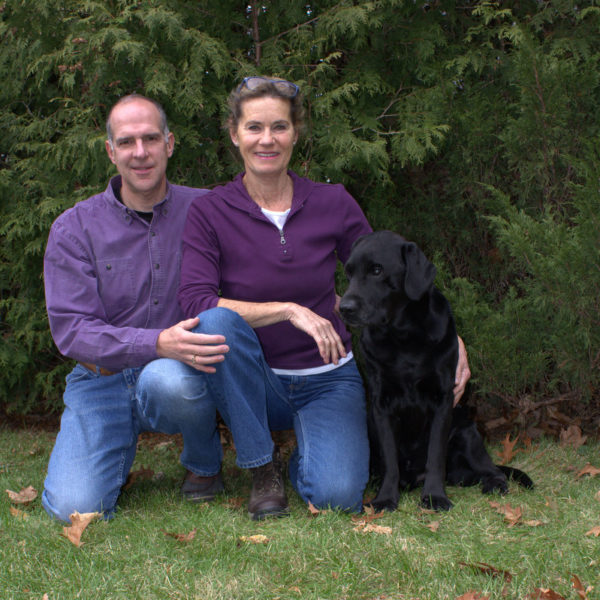
Donna and Peter made their initial donation to the Ontario SPCA after the passing of their beloved dog Dalwood, memorializing him with a plaque at our York Region Animal Centre.
Since learning more of our other work in the province, they have made additional donations and a three-year pledge commitment to our Provincial Dog Rehab Centre campaign. This donation also memorializes Dalwood at the new site.
Peter’s work history involved working extensively in Northern Ontario, and as such he’s extremely interested in our programs supporting the North, partnering with dozens of communities to help pet overpopulation and bring critically needed animal welfare services to the remote north.
“We love all animals (dogs in particular). Yet, we know that many animals need help, through no fault of their own. Therefore, the welfare of animals has become our cause of choice and the Ontario SPCA our charity of choice to help lost, abused or abandoned animals find their chance for a happier life and a forever home. Caring for animals simply makes the world a better place, and we’re happy to do our part.”
On behalf of the animals, we thank Donna and Peter for the generous support they provide.




This Remembrance Day, join us as we reflect on the sacrifices of our veterans who have served Canada and the courageous animals who stood by their sides in times of war and peace.
More than just companions
During wartime, dogs had a variety of valuable roles. One role was as mascots and companions to front-line soldiers. In this role they not only gave soldiers hope at the front lines but also helped to decrease the number of rodents in the trenches by scaring them away.
Dogs also carried written messages between units, and were employed to lay telephone lines. Spools were laid on the dogs’ backs that would unroll as they moved forward. Dogs could also smell poison gas before soldiers, locate wounded soldiers on the battlefield, and carry medical backpacks.
Mascots and protectors
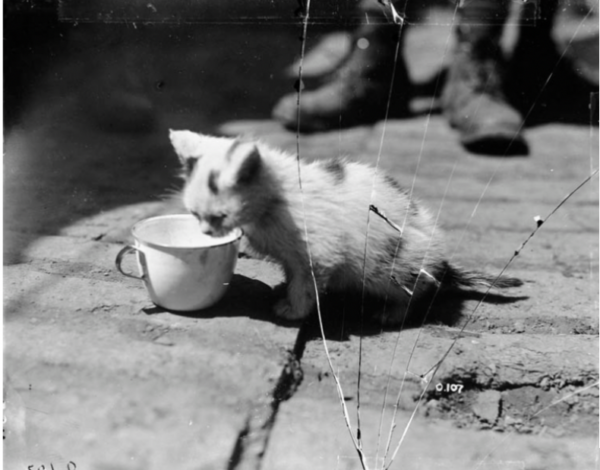
Like dogs, cats served as companions and mascots in wartime. Aboard naval ships cats not only protected food rations from rodents but also prevented communication lines from being chewed through by rodents. Controlling the rodent population also lessened the spread of disease.
Cats have been known to detect bombs, with families relying on their cat’s senses to alert them to incoming bombs. Read more about the role of cats in wartime here.
Brave messengers of the skies
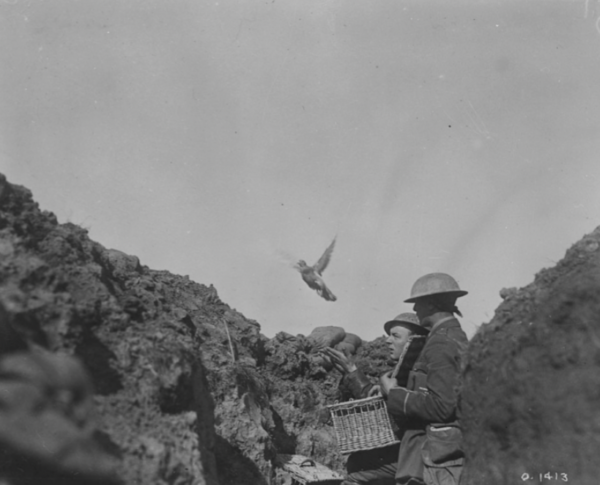
During both World Wars, carrier pigeons delivered messages across the lines. It was a very dangerous job with the enemy always trying to shoot them down. During the First World War, 600 pigeons were used in France alone by the U.S. army. The United Kingdom employed about 250,000 homing pigeons during the Second World War for many purposes, including communicating with spies behind enemy lines.
Canaries were used in wartime to detect poison gas at the front line. They could also signal a lack of oxygen in the tunnels.
Battling side by side
During both World Wars, mules carried artillery, and horses transported troops and hauled field guns, among many other vital roles. Horses and mules were used by the Canadian Army Service Corps to carry mounted troops, panniers, artillery and haul field guns.
Read more stories of horses in wartime here.
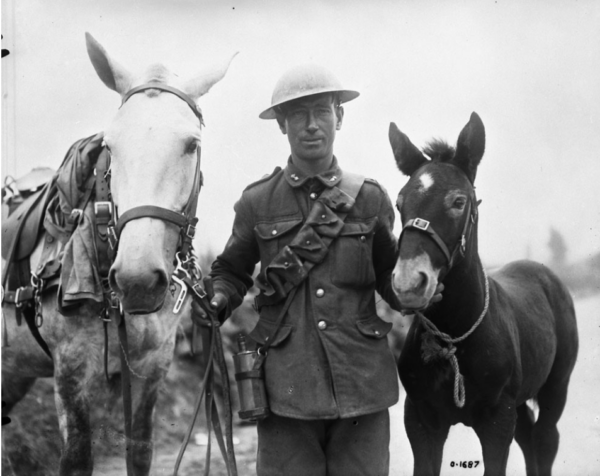
This Remembrance Day, join us in remembering the sacrifice of those who fought for our freedom and the safety of our country. We will never forget.
Weight management is so important for your companion animal and maintaining a healthy diet contributes to healthy weight. So what difference would an extra 2lb really make?
Our friends at Royal Canin know that sometimes, it’s easier for us to think about our own weight gain and loss, rather than our furry friend’s weight. Using this simple guide, you can see just how important it can be for your companion animal to maintain a healthy weight. With even just a couple of pounds, your animal’s weight and health can change drastically.
Infographic_What an extra 2lb can mean for a pet_EN (1)
Always remember to consult your veterinarian if you are concerned about your animal’s weight. They can help guide you to ensure you are feeding your companion animal the correct amount, getting them the necessary exercise they need and managing their treat intake to ensure they are happy and healthy.
For more information on weight management, check out these resources from Royal Canin:
Three hidden costs of animal obesity
Healthy habits, healthy weight
Helping your cat maintain a healthy weight
November 8 is Indigenous Veterans Day. It is a time to remember and honour the thousands of First Nations, Inuit, and Métis who served in the First and Second World Wars, as well as the Korean War. Learn more here.
During these three wars, more than 12,000 Indigenous veterans served with honour and distinction at every level and in all areas of service. Indigenous Peoples continue to serve in operations at home and overseas as they have bravely done for more than 200 years.
On this day, and on Remembrance Day, we reflect on the important and notable contributions made by Indigenous veterans. We also acknowledge the challenges faced by survivors when they returned to a denial of benefits and support, as well as loss of land and rights. It wasn’t until 1995 that Indigenous veterans were included in the laying of wreaths at the National War Memorial in Ottawa, in honour and memory of their fallen comrades.
In 2001, the National Aboriginal Veterans Monument was unveiled to honour the sacrifices and contributions to war and peacekeeping missions. This monument, crafted by artist and sculptor Noel Lloyd Pinay of Peepeekisis First Nation, features two men and two women, as well as four animal spirit guides and an eagle, representing the Creator. To learn more about the rich symbology in this sculpture, visit the National Aboriginal Veterans Monument page.
We remember, celebrate and honour the sacrifices and peacekeeping efforts of all Indigenous veterans on this day and every day. Join us in honouring Indigenous Veterans who have served in missions across Canada and around the world in times of war, conflict and peace.
Photo Credit: Tamra Thomson, Great War 100 Reads
If you’re thinking of adopting an animal or acquiring a new furry friend from someone online, there are a few things to remember to protect yourself before making that important decision.
Adopt
The safest way to add a new furry friend to your family is by adopting from a reputable organization. There are thousands of homeless animals in shelters across Canada, so you will also be giving an animal in need a second chance.
At the Ontario SPCA and Humane Society, you can view our animals currently available for adoption and read their bios to see if you think they would be the perfect match for you and your lifestyle. With 14 animal centres across the province, we have many animals ready to become a beloved member of your family.
Consider visiting your local animal centre today to change the life of an animal.
Ask lots of questions!
Remember to ask about where the animal has come from. Ask about any veterinary care they may have received, and the name of the veterinarian who has examined or treated the animal. Make sure the individual or organization you are dealing with has vaccination certificates, proof of de-worming and a general health assessment in writing from their veterinarian. You should be able to verify these yourself directly with the veterinary office.
All animals adopted through the Ontario SPCA are vaccinated, spayed or neutered, and microchipped before they go to their new home. This ensures they start their new life healthy and protected. These essential services are part of the adoption package, so you can focus on welcoming your new family member without any worry.
Always meet in advance, and safely!
You should always meet the prospective pet, and its parents (human and animal) in person. Always meet at the person’s property (take someone along for safety), never in a parking lot or other unsafe area, and do not allow them to come to your home. You want to see that the animals are being raised or cared for in a clean, safe environment, that they are receiving good care, and that the animals are bright, alert and responsive.
Puppies and kittens should be playful and have lots of energy. If a breeder will not show you their facilities, or let you see the animal’s parents, these may be warning signs of an issue. A reputable breeder will never have a problem letting you see how their animals are raised. A good breeder cares about the animals and wants them to go to a good home.
You should also meet the animal first when adopting to ensure that their temperament and needs fit your lifestyle. Ontario SPCA staff are always happy to answer any questions you may have and support you along the adoption process.
Payment
Payment options should be limited to cash with a receipt. Never give out your banking information or agree to large deposits in advance. If someone says they need a deposit to hold an animal for you before you meet them, this is another red flag. Just let them know that you are not comfortable with this arrangement, and a reputable breeder should be open to discussing other options with you.
If payment is being done via e-transfer, treat it like cash and only send once you have acquired your new furry friend.
Additional resources
If you have any concerns relating to abuse or neglect, report it to Provincial Animal Welfare Services at 1-833-9ANIMAL (1-833-926-4625), or your local police.
If you are concerned that you may be the victim of a scam, contact the Canadian Anti-Fraud Centre at antifraudcentre-centreantifraude.ca
If you aren’t sure whether you want to adopt or find a breeder, read our blog on why adopting from the Ontario SPCA is the perfect choice. Remember to check your local Ontario SPCA animal centre, SPCA, humane society or rescue for animals who may need a second chance. For a list of Ontario SPCA animal centres, visit our community directory.
To view our animals currently available for adoption, visit ontariospca.ca/adopt
If this information was helpful, please help us continue to educate about pet health and well-being by making a donation. As a registered charity that does not receive annual government funding, the Ontario SPCA and Humane Society depends on the generosity of donors to change the lives of animals in need.
IMMEDIATE RELEASE
Barrie, ON (November 5, 2025) – The Ontario SPCA and Humane Society and Barrie Police are teaming up to make the holidays merry and bright for animals in the community by hosting a Cram a Cruiser event on Thursday, Nov. 13 to collect much-needed supplies.
The cruiser will be parked outside PetSmart at 33 Mapleview Dr. W. in Barrie from 2 p.m. to 6 p.m. and the public is invited to drop off donations of food, treats and toys for cats and dogs, as well as supplies such as bowls, leashes, collars and dog jackets. The donations will be distributed by the Ontario SPCA and partnering organizations to people in the community who need support caring for their animals.
“Anyone who has ever loved a pet knows how important that bond is, and we want to ensure that people who may be struggling have what they need to give their animals the care they deserve,” says Shannon Laflamme, Community Outreach Coordinator, Ontario SPCA Barrie Animal Centre. “Our goal is to keep animals with the families who love them and make this a happy holiday season for everyone.”
The Ontario SPCA is a registered charity that is 100 per cent donor funded. It offers a variety of community support services, including distributing pet food to area food banks. To learn more, or to donate, visit ontariospca.ca/barrie
##
MEDIA CONTACT
Shannon Laflamme
Community Outreach Coordinator,
Ontario SPCA Barrie Animal Centre
(705) 791-4957
[email protected]
The Ontario SPCA and Humane Society
The Ontario SPCA and Humane Society is a registered charity that has been changing the lives of animals for over 150 years. The Society provides care, comfort and compassion to animals in need in communities across Ontario. It values all animals and advocates to treat them with respect and kindness. The Society strives to keep pets and families together and does so through a variety of community support services, such as sheltering and adoptions, including emergency sheltering, feral cat management programs, animal transfers, food distribution, humane education, animal advocacy, and spay/neuter services.
The Ontario SPCA does not receive annual government funding and relies on donations to provide programs and services to help animals in need. To learn more, or to donate, visit ontariospca.ca. Charitable Business # 88969-1044-RR0002.
The Ontario SPCA Barrie Animal Centre is situated on the traditional land of the Anishnaabeg people. The Anishinaabeg include the Ojibwe, Odawa, and Pottawatomi nations, collectively known as the Three Fires Confederacy.